Personal Profile
Personal Profile

Novel Multifunctional Soft Actuators


One of the common methods to deliver the actuation energy to the thermal responsive materials is delivering electrical power through compliant electrodes for Joule-heating. Although the actuator would be tethered (unless it’s carrying a battery as the source), it can be stimulated more accurately and locally. By achieving multi-functionality through this, many interesting applications, soft robots, in particular, can be explored. However, the integration of traditional metallic thin films often limits the morphing as they are intrinsically stiff and inextensible. The idea is to harness Joule heating from electrodes that power the actuation but provide negligible mechanical constraint that stands in the way of the LCE's response.
To solve this, we employed two different approaches. First in a collaboration with Dr. Bartlett from Virginia Tech, we used intrinsically stretchable liquid metal (LM) thin films as compliant resistive heaters. Initially, the droplets are intact and insulating, upon mechanical pressure they are ruptured to form a conductive surface while maintaining electrical insulation on the bottom surface. The actuator was able to demonstrate reversible 15% deformations (1 × 10⁻⁵ N.m) by consuming small electrical power (<500 mW).
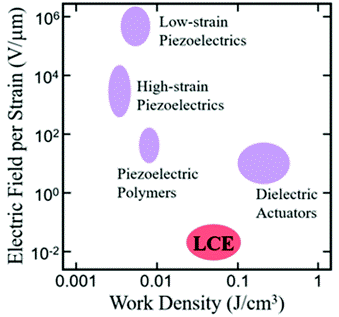
In another approach, we prepared composites of LCE with embedded LM droplets. We studied the effect of chain extender structure and composition on the thermomechanical properties of LCE. The composite actuators were stimulated by directly applying 2V (~115mW electrical power), generating ~2 J/kg specific work (67mJ/cm3 work density), and lifting loads as heavy as 260 times of its weight.
Designed mechanisms (future work)

Publications
Ph.D.


